Glass Hammers
(available in Apricot, Jade, Copper blue, Clear, Fuchsia)
Kiln cast glass, found objects, ebony
(330mm x 240mm x 180mm)
Each £480


These new edition glass hammers are a continuation of Rosie’s ‘impotent tools’ from her graduate collection, For a Man of Substance, inspired by ‘The Cabinet Maker’s Toolbox’ made by English furniture company Benchmark.
The Cabinet Maker’s Toolbox was made for Sir Terence Conran’s 80th birthday in 2011, but has also been available as a made-to-order item for some years now. One website that was marketing the toolbox caught Rosie’s eye… It described the toolbox as “a beautifully crafted set of manliness … that makes you reminisce about all those days when your special man potters around the house in his faded denims fixing everything you broke.”
Sometimes items are marketed at men as a representation of their potential for masculinity. However, in The Cabinet Maker’s Toolbox clearly the tools and their display are too beautiful to risk damage in functional use; their beauty is legitimised for men through their association with masculine functional use. In this sense, it is not the ‘tools’ that represent stereotypical masculinity, but ‘using the tools’ that represents it. Ironically, these decorative qualities mean that many would choose not to use the toolbox in a practical sense.
In contrast, many functional items are decorated to comply with our culture’s attitude toward women and practicality. This is because beauty is heavily associated with femininity. Just as there is an expectation on men to be practical and demonstrate their masculinity, there is also an expectation on women to be decorative in order to demonstrate their femininity.
For A Man of Substance is now in the home of a Private Collector, but Rosie has extended her collection of impotent tools and continues to make smaller groups of luxurious glass tools bringing together practicality – through the use of once-functional, found objects – and decorativeness in an open, frank and ironic way.
Lily Castrator
(for the stubborn stamen in your life)


Rosie was invited to take part in a project with five other contemporary craft makers. The brief was to create their own idea of a ‘tool’ which would be sent on to another maker to be used to make a new object.
Rosie’s practice is heavily influenced by existing tools so to be able to create her own tool was an exciting notion. But with so many tools out there already she wondered what to make:
“Talking about some of my ideas with my oldest friend, something triggered a memory from my childhood: when I was younger, I remember walking into the kitchen and my mum was snipping parts off a bouquet of lilies that she had bought. I asked her what she was doing and she said that she was removing the stamen from the lilies because the pollen on them made her sneeze and it stains everything.
Later, I remember learning about the parts of a flower in biology, and it made me think about the time my mum was cutting the stamen off. I thought… she’s cutting the male part of the flower off… and as the formidable woman she has always been, it seemed really amusing and quite fitting that this act of ‘lily castrating’ is what she was doing.
I began to wonder about the act of buying and displaying flowers, a pastime that seems to be performed mainly by women. The amusing image of a Women’s Institute group meeting to buy lilies and snip off the pollen together came into my mind. An act done for very practical reasons, but that could be interpreted as an ‘anti-men’ ritual. I designed the Lily Castrator as a tool for the easy removal of stubborn stamen wherever a woman finds herself.”
The Lily Castrator is made of plated bronze blades, just sharp enough to remove that stubborn stamen from your life, but harmless enough so that you can wear it around your neck without worry of the potential of accidently snipping something else. Available in plated 9ct gold, silver and oxidised silver with various coloured cords of your choice.
Silver plated lily castrator
with pale blue satin cord & solid sterling silver clasps
(40mm x 68mm x 16mm)
Each £239
Silver plated lily castrator
with jaffa orange satin cord & oxidised solid sterling silver clasps
(40mm x 68mm x 16mm)
Each £239
24ct gold plated lily castrator
with black satin cord & oxidised solid sterling silver clasps
(40mm x 68mm x 16mm)
Each £257
The Morris & WilMo Collection
(after ‘Strawberry Thief’, William Morris)
“Have nothing in your house that you do not know to be useful or believe to be beautiful.” – William Morris.


Rosie has always been fascinated by the relationship between beauty and utility. These pieces are an investigation into the contrasts and opposition between craft and mass-production.
William Morris was particularly damning of mass-produced objects, believing them to be “soulless”. Mass-produced objects lack the lineage of handcrafted objects due to their absence of human connections. Like William Morris, Rosie believes that craft should be integral to the creative process and that the inherent value of a handmade object cannot be replicated in a mass-produced commodity. She noticed that there is a tension in Morris’ ideals: as a socialist he believed art should be accessible to all, despite the prohibitive costs of handmade objects to the working classes in an industrialised society. How could these things be compatible? How could craft be mass-produced? Was this idealistic view, of affordable hand-crafted art for everyone realistic?
These pieces, particularly, the ‘Wilmo’ Tenon Saw, investigate the contradictions in William Morris’ ideals – his love of traditional craftsmanship and his egalitarian desire to make ‘affordable art for all’ – and question whether objects deemed ‘beautiful’ could also be considered inherently ‘useful’, as aesthetic appreciation can be a kind of function in itself.
Rosie explains: “I wanted to ‘bring back’ the value of craft into tools that are no longer commonly used, or are disregarded due to being commonplace, by introducing Morris’s famous repeating pattern design ‘Strawberry Thief’ by hand into the tools. I have chosen Strawberry Thief because as well as being one of his most popular designs, it is one of the most exploited in terms of the pattern being used on so many mass-produced items today.”
All these pieces have been intricately perforated by hand using a jeweller’s saw in a laborious and painstaking manner – similar to the way Morris created many of his wondrous works. “I am always surprised when people who see my work immediately think it has been laser-cut, I enjoy the expression on their faces when I tell them it’s all been cut by hand!”
Tenon Saw (after ‘Strawberry Thief’, William Morris)
Hand-pierced brass, found handle, ebony, cattle bone
(400mm x 132mm x 22mm)
£5,000
Carpenter Square (after ‘Strawberry Thief’, William Morris)
Hand-pierced brass, found handle, ebony, cattle bone
(88mm x 130mm x 12mm)
£1,600
‘WilMo’ Tenon Saw (after ‘Strawberry Thief’, William Morris)
‘Wilko’ hand saw, hand-pierced aluminium blade
(345mm x 160mm x 27mm)
£2,800
Thirty Seven Percent
Inspired by ‘the pink tax’
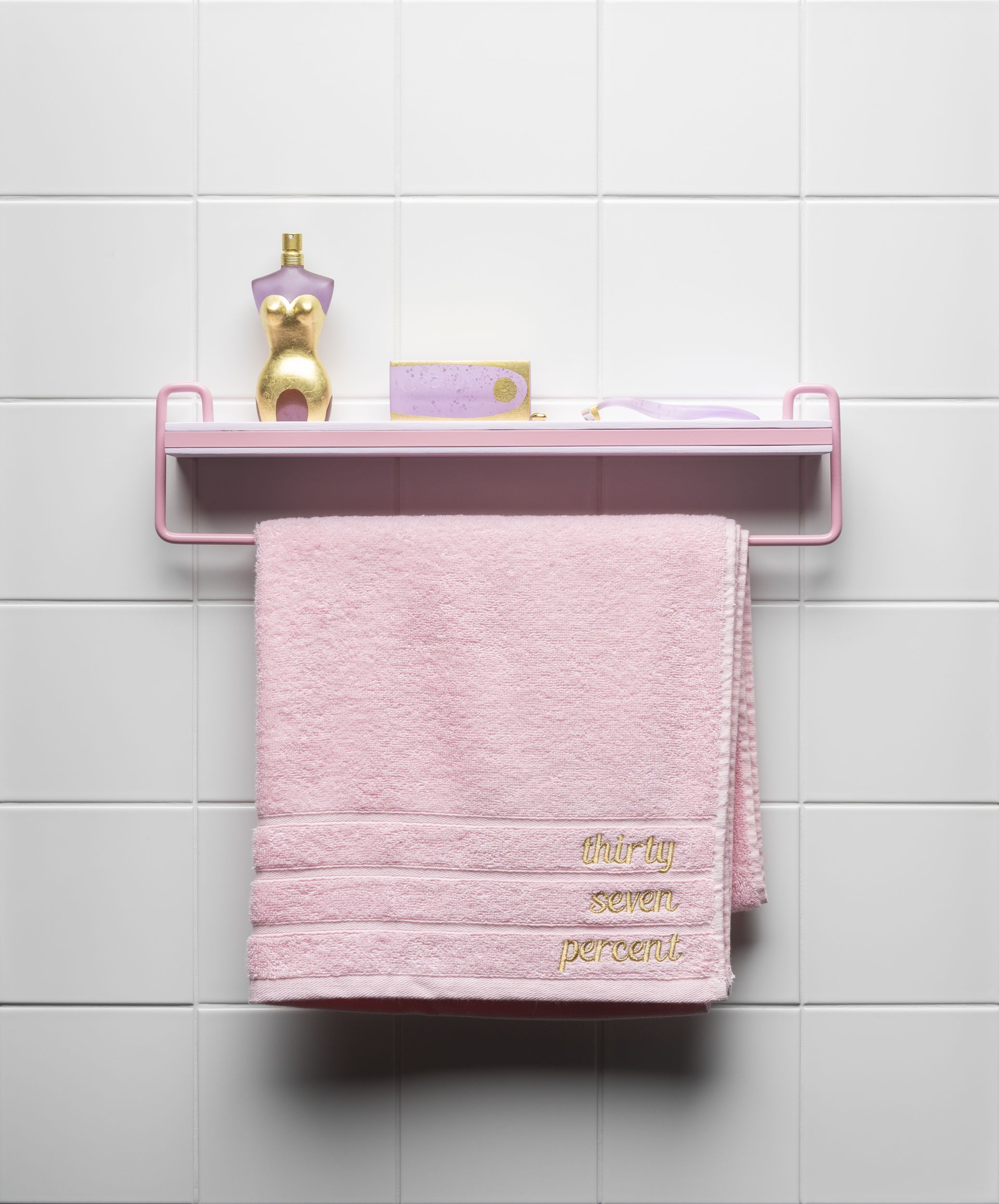
Thirty Seven Percent is inspired by ‘the pink tax’, which is the term used to refer to products marketed specifically towards women that are more expensive than those marketed towards men. These products are often, stereotypically, pink in colour. Gender based pricing is the practice of charging a different price for the same consumer goods or services on the basis of gender.
Publication of research undertaken by The Times and debated in the House of Commons in 2016 found price disparities across a wide range of gender-targeted items, with those marketed at women 37% more expensive on average. Thirty Seven Percent is an ensemble of luxurious gold and premium-ly, pink-ly priced products.
Thirty Seven Percent
Pink shelf and towel rail with gilded glass period pain packet, gilded glass perfume bottle, gilded glass razor, 18ct gold ‘Nurofem’ necklace and embroidered pink Thirty Seven Percent towel.
(240mm x 70mm x 205mm)
£5,000
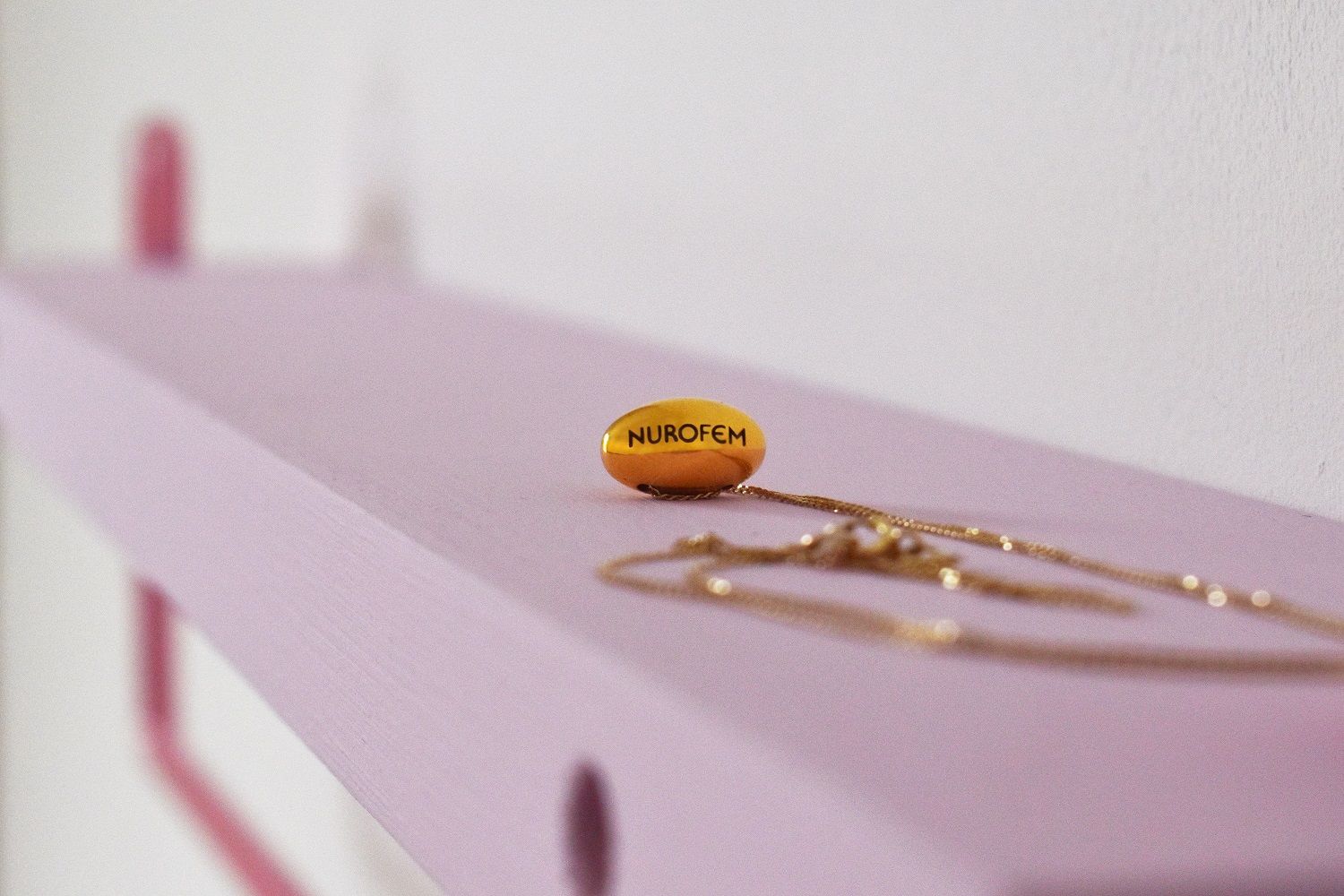
‘Nurofem’ gold necklace
18ct gold plated silver, with 9ct gold chain
£480
‘Nurofem’ gold stud earrings
18ct gold plated silver
£450
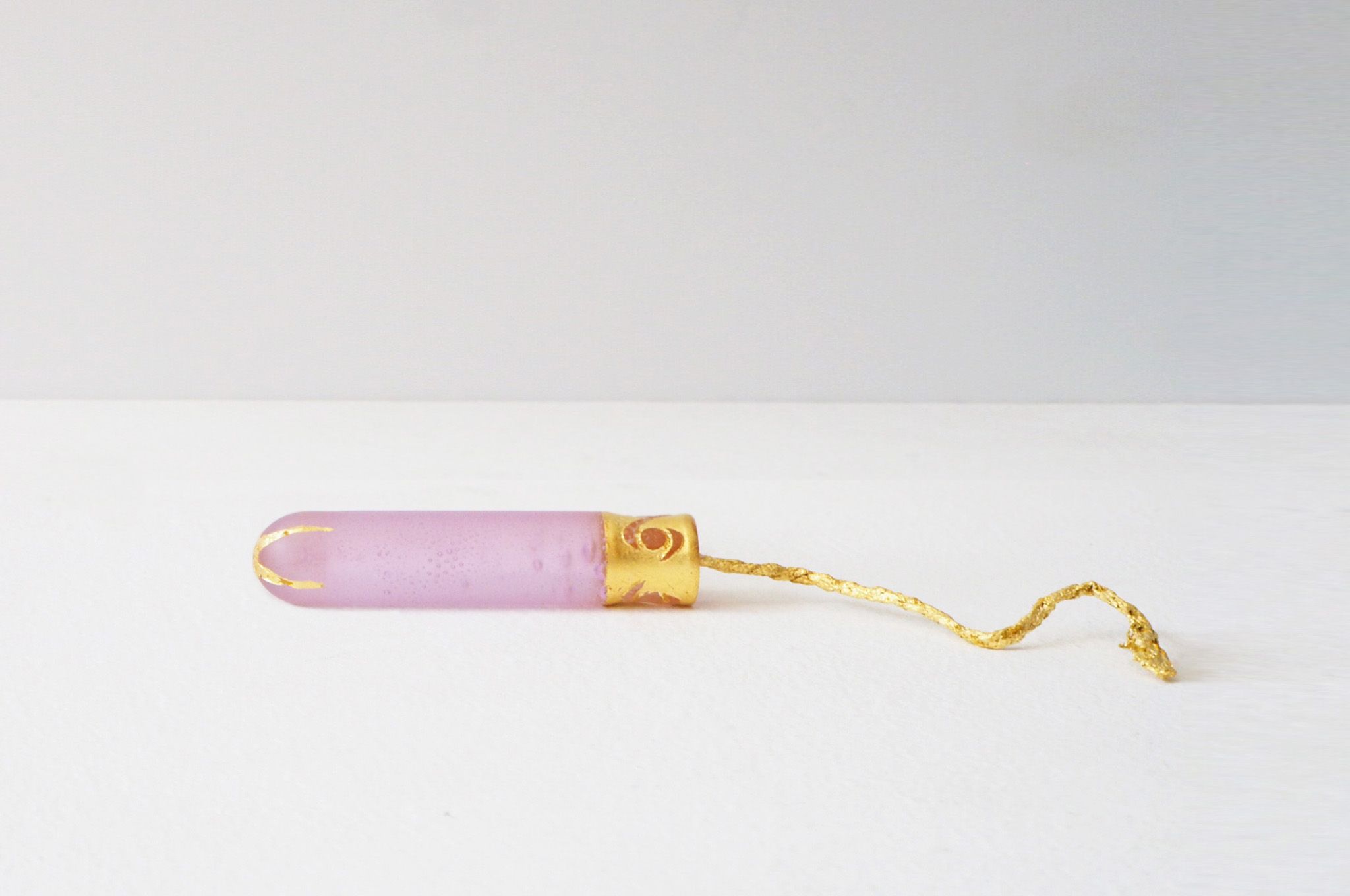
Tampax Pearl Compak
Kiln-cast glass, tampon string, 22ct gold leaf
£520